


Mothman is a winged figure reported near Point Pleasant, West Virginia, whose red-eyed image grew from roadside encounters in 1966 into a celebrated local legend.
Mothman
On a November night in 1966, two young couples drove past a disused wartime powerhouse near Point Pleasant, West Virginia, and saw something tall and winged with glowing red eyes. It seemed to follow them back toward town, and the next day's newspaper could only offer a string of uncertain names: bird, creature, something. Within days a name, a crowd of searchers and an ornithologist's explanation had arrived. A year later a bridge fell, the story acquired a prophecy, and Mothman became one of America's most famous legends, with a festival, a museum and a statue of its own. [9][1]
Read the manuscriptCreature profile
- Home ground
- Point Pleasant and the former wartime TNT works, later used for wildlife management. [8][1]
- Early explanation
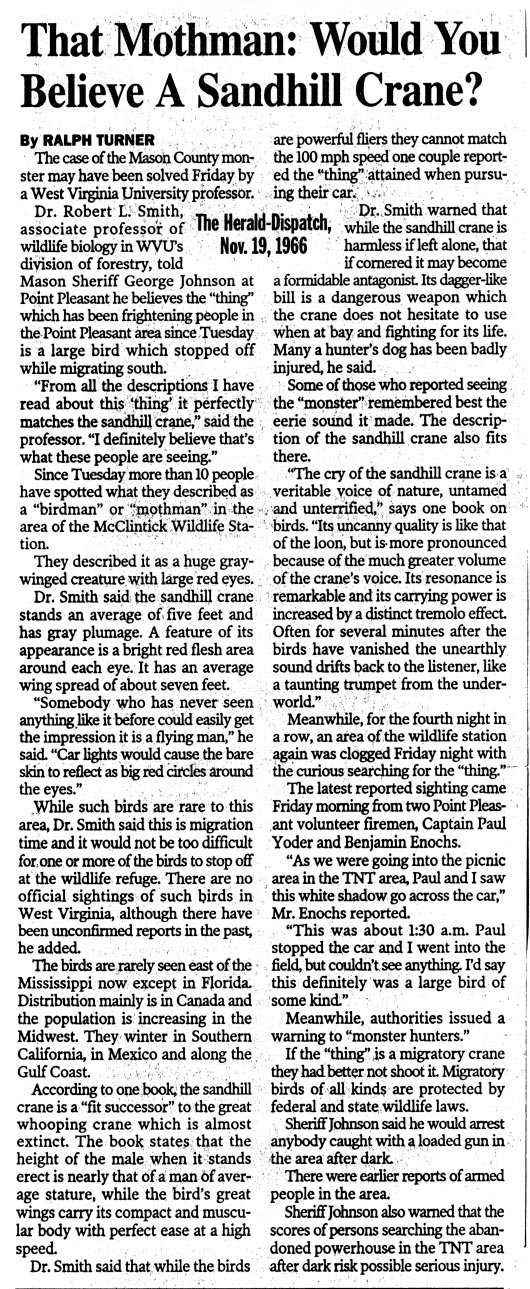
- In November 1966, wildlife biologist Robert L. Smith proposed a sandhill crane; in 2018 Joe Nickell argued for a barred owl. [2][6]
- A different description
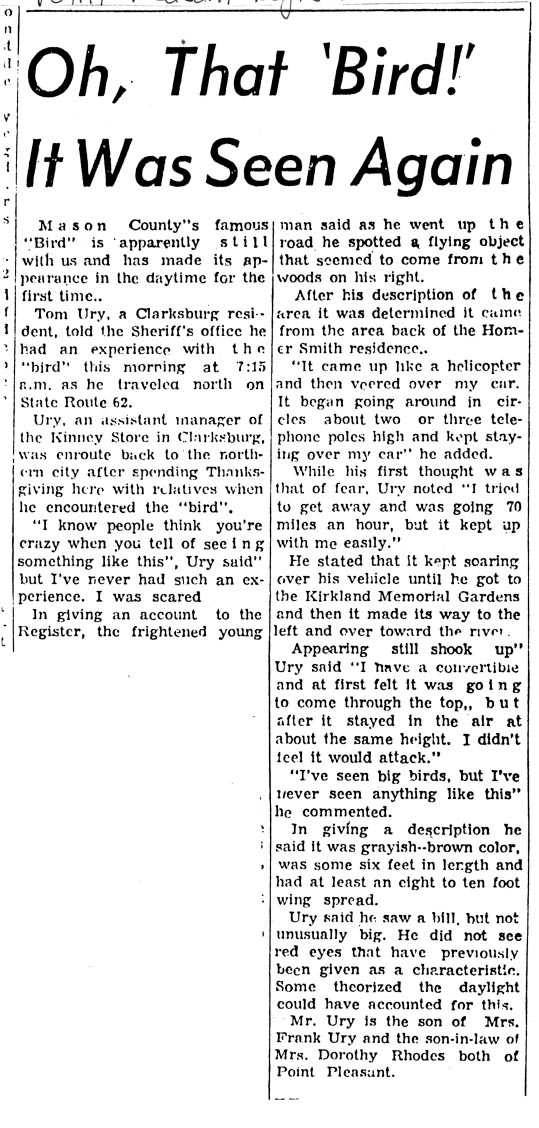
- Tom Ury reported a bill and explicitly said he saw no red eyes. [4]
- A separate investigation
- The National Transportation Safety Board traced the 1967 Silver Bridge collapse to a critical flaw and fracture in an eyebar. [7]
Names & Creature Profile
Mothman is a tall, winged, red-eyed figure first reported around Point Pleasant, West Virginia, in November 1966. The name arrived within days, courtesy of the local press, and it stuck so firmly that it now names a museum, a festival, a statue, a book and a Hollywood film. Gordon Simmons's entry in the West Virginia Encyclopedia counts twenty-six reported sightings over the following year, mostly in and around the old wartime TNT plant north of town. [1][4][9]
The earliest accounts are less uniform than the later picture. The two couples who started the story described a man-sized bird with glowing red eyes. Tom Ury, who reported a daylight encounter a few days later, described a grayish-brown figure with a bill and said plainly that it had no red eyes. Audubon magazine gives the creature's reported height as about six feet, a good deal smaller than the looming figure on modern posters. [6][4]
Tales & Encounters
The story begins at the old TNT plant on the night of 15 November 1966, when two young couples, the Scarberrys and the Mallettes, drove past the disused powerhouse and saw a tall winged figure with red eyes. Roger Scarberry sped away; the figure appeared to follow. Gwen Mallow's later Smithsonian account adds that it rose into the air and kept pace as the driver accelerated toward town. Officers searched the area afterward without finding it. [9][5]
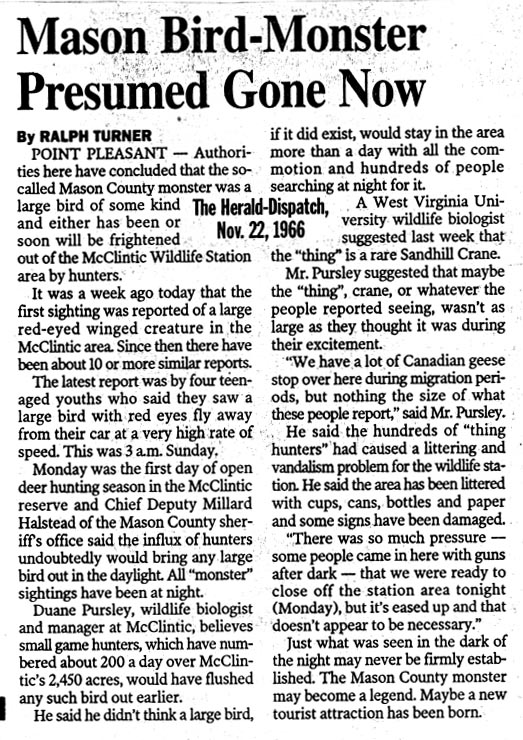
The next reports brought a different sort of traffic. Turner's article of 22 November describes hundreds of people searching at night. Four teenagers said that a red-eyed bird had flown away from their car early on Sunday. Wildlife manager Duane Pursley doubted that a large bird could remain hidden after hunters had disturbed the area, and the authorities presumed that it had gone, or would soon be frightened away. The searchers left an easier trail to follow: litter built up and signs were damaged. An absent creature had brought a very tangible crowd into the wildlife grounds. [3]
A Register clipping dated 25 November gives Tom Ury a daylight journey. Driving north on Route 62 at about 7:15 in the morning, he saw a flying object come out of woods on his right and circle above his convertible. He accelerated to about seventy miles an hour and said that it kept up. Near Kirkland Memorial Gardens the object left him, crossed a field and flew toward the river. He described a grayish-brown figure with a bill, and said explicitly that he had not seen red eyes. [4]
Historical Record
The Point Pleasant Register carried the first report on 16 November 1966 under a headline that could not settle on a name: "Couples See Man-Sized Bird...Creature...Something!" Two couples, the Scarberrys and the Mallettes, said they had been near the old power plant the night before and had seen a tall winged figure with red eyes. When Roger Scarberry drove away, they said, the figure took to the air and followed them. [9]
Within days the story had acquired a name, a proposed explanation and a crowd. Ralph Turner's articles in the Herald-Dispatch record hundreds of people searching at night, warnings against shooting protected birds and entering the abandoned powerhouse, and a wildlife manager who thought a large bird could not stay hidden after so much disturbance. Four teenagers reported a red-eyed bird flying away from their car early on a Sunday. The authorities presumed that the creature had gone, or would soon be frightened off. [2][3]
The sightings continued for about a year. Simmons counts twenty-six in the twelve months from November 1966, and notes that rumors grew alongside them: failing phones, radios, televisions and cars, reports of UFOs and mysterious visitors. A New York writer and paranormal investigator named John Keel gathered much of this material and built it into a single narrative. Sightings diminished after the collapse of the Silver Bridge in December 1967, which Keel's account placed at the climax of the story. [1]
Homeland & Tradition
The initials TNT in the "TNT area" say what the land was for. The U.S. Environmental Protection Agency (EPA) records that the West Virginia Ordnance Works manufactured the explosive there from 1942 to 1945, shipping it elsewhere instead of loading shells on site. Before the government bought the property in 1942, about half of it was cropland, and forest, pasture and roughly thirty farm residences made up the rest. The purchase also took in the National Guard's Camp Conley. [8][10]
After the war the land passed to the state for wildlife management, and more than thirty shallow ponds were built to encourage wetlands and waterfowl. People fished and hunted there. By 1966 the area was a mix of abandoned powerhouses and industrial structures scattered through marsh and woods, a very good setting for a story about something large moving unseen after dark. It was neither untouched wilderness nor a barren ruin, and that mixture goes a long way to explaining why a monster report felt believable to the people who heard it. [10][8]
Appearance & Signs
The first witnesses described a creature the size of a man, with gray wings and a pair of glowing red eyes. The eyes are the feature that survived, and in the retelling they became the creature's signature. In the original reports the figure stood, then rose into the air and followed the car, which was part of what frightened people most. [9][2]
Audubon's reporting notes that the creature was reportedly neckless, with the head set directly between the shoulders. Ury's bill and grayish-brown body, and his remark that he saw no red eyes, show that even in the first week people were not describing quite the same thing. [6][4]
The folio for this entry gathers the best-known features into a dark, shaggy figure above a wooded river: broad wings, bright eyes and dangling hands that give it a human outline. The bill from Ury's daylight account has no place in it. The picture is a modern interpretation of the legend, not an illustration of any single report. [4][1]
Nature & Powers
Mothman's one reported talent is flight, and the early accounts use it in a particular way. The couples drove away at speed and said the figure kept up with them, rising and following the car back toward town. Ury accelerated his convertible to about seventy miles an hour and said that the object kept pace, then reasoned that because it stayed aloft it was unlikely to attack through the roof. Neither account gives the figure a voice, a message or a stated purpose. Whatever intention it had was something the witnesses worked out while trying to get away. [9][4]
The powers that now go with the name arrived later. Simmons notes the rumors of interference with telephones, police radios, televisions and automobiles during the sighting year, and Keel's book added men in black and prophecy. In the later legend Mothman is an omen, a warning of disaster. That is a retelling, built on events that followed the first sightings, and it appears nowhere in the original newspaper reports. [1]
Variants & Kindred Beings
The first explanation came in the first week. In a 19 November 1966 article, wildlife biologist Robert L. Smith suggested a sandhill crane, a tall gray bird with a patch of red skin on its face that can look vivid in headlights. The idea gave worried residents something ordinary to look for, but no captured bird ever settled the encounters. Audubon's 2018 reporting notes a weakness: sandhill cranes are not native to West Virginia, and witnesses described a creature with no neck. [2][6]
Later skeptics substituted an owl. In Asher Elbein's 2018 Audubon article, investigator Joe Nickell, who had earlier traced the 1952 Flatwoods Monster to a barn owl, first suspected a barn owl here too. He judged its eyeshine too weak to match the red eyes and settled on the barred owl, a common bird of the region, 17 to 20 inches long, whose eyes can glow crimson in headlights. Elbein reports that officials confirmed a barred-owl population in the former TNT area, now the McClintic Wildlife Management Area. Nickell also points out that Linda Scarberry described huge, glinting red eyes in the car's headlights, which fits eyeshine. Elbein adds that a snowy owl was shot by a local man in the first weeks of the reports, and that firefighters reported seeing a large unidentified bird. [6]
Elbein also describes a 2010 television experiment in which volunteers drove past roadside plywood cutouts with bicycle reflectors for eyes. None of them guessed the size of the cutouts correctly. Nickell's point is that at night, with the distance unknown, a misjudged distance means a misjudged height in the same proportion. A crane's red face and an owl's eyeshine work by different mechanisms, and no animal was ever recovered from the original encounters, so each remains an informed guess. [6]
Landscape & Associations
The original search had hazards of its own. Turner recorded officers' warnings against shooting migratory birds and against entering the abandoned powerhouse after dark. The proposed identification therefore had a practical consequence: a hunt for a monster could turn into an armed hunt for an ordinary bird, and the old buildings were dangerous in the dark whatever lived in them. [2]
The setting also changed after the sightings. West Virginia's 2006 groundwater report records red wastewater seeping near Pond 13 in 1981, which led to investigations of contamination left by TNT production. Buried wastewater lines still contained crystalline explosive. The cleanup included removing contaminated lines and disposing of asbestos, and the report dates the demolition of the north and south powerhouses, and the filling of open pits and manholes, to January 1995. Replacement wetlands were built where the work had damaged habitat. The powerhouses of the 1966 reports no longer stand. [11]
Later Retellings & Reception
Keel's The Mothman Prophecies appeared in 1975. It joined the Point Pleasant sightings, the rumors of men in black and the Silver Bridge collapse of 15 December 1967 into one narrative of warning and aftermath, and it became the basis of a 2002 feature film starring Richard Gere. The prophecy story looks backward from catastrophe: an earlier appearance turns into an omen only when it is told in light of what happened later. [1]
The town has embraced the story. Simmons reports that the annual Mothman Festival, held each September, draws more than four thousand people for talks by Mothman experts, hayrides and storytelling, and that a life-sized Mothman sculpture was installed in downtown Point Pleasant in September 2003. Mothman has also reached literature: Pinckney Benedict's novel The Dogs of God contains a brief Mothman appearance, and Chuck Kinder's 2004 memoir The Last Mountain Dancer gives him a prominent role. The future short-story writer Breece D'J Pancake wrote to the Huntington Herald-Dispatch in 1966 arguing that the creature was really a California condor. [1]
The legend has also traveled. From 2011 to as recently as 2020, a Mothman-like figure was reported many times in the Chicago area, and nobody can say whether it is a separate creature or the West Virginian one on the move. [1]
Evidence & Open Questions
The bridge investigation followed an entirely different chain of events. At about five in the evening on 15 December 1967, the Silver Bridge between Point Pleasant and Kanauga, Ohio, collapsed, killing forty-six people and injuring nine. The National Transportation Safety Board (NTSB) traced the failure to eyebar 330 in the suspension chain on the Ohio side. A critical flaw there had developed through stress corrosion and corrosion fatigue. When the bar fractured, the chain lost its continuity and the collapse progressed toward the West Virginia shore. [7]
The NTSB found that the hidden flaw could not have been detected by the inspection methods available without disassembling the joint. An unseen structural defect is not an unexplained disaster: the report gives the collapse a material cause and a sequence, and it needs no creature to explain it. What remains open is the identity of the thing the couples saw. The contemporary clippings leave a crane, an owl or an unrecovered stranger as the candidates, and readers may weigh them differently. [7]
Meaning & Belief
The most popular explanation for why Mothman came to Point Pleasant is not zoological. Simmons reports a theory connecting the creature and the Silver Bridge disaster to a curse of roughly two hundred years' standing, attributed to the Shawnee chief Cornstalk, who led Native forces at the Battle of Point Pleasant and was later murdered there. In this version the winged figure becomes a messenger or a harbinger of loss. The curse story belongs to the folklore that gathered around Mothman, not to the 1966 reports. [1]
Turner's November follow-up had already wondered whether the mystery would become a tourist attraction. Decades later, Mallow found a town making that happen on its own terms. Point Pleasant resident Jeff Wamsley, whose father worked at the National Guard Armory, opened a museum in 2006 to show the archival material he had gathered, including police reports and witness accounts. Mallow's 2021 article describes that museum, Bob Roach's public sculpture, a festival, merchandise and café treats. Folklorist Rosemary Hathaway connects the local storytelling with an identity that reaches beyond the mining and industrial stereotypes outsiders bring to West Virginia, and Wamsley emphasizes how many visitors want to investigate and decide for themselves. A place people once sped away from has become somewhere they travel deliberately to meet a story. [3][5]
Sources & Manuscript Notes
The four 1966 clippings anchor the encounters and the immediate response. Simmons follows the legend's chronology and later reception, Mallow reports its community life, and Elbein examines the owl explanation. EPA and West Virginia environmental records establish the changing landscape, and the NTSB summary supplies the findings on the Silver Bridge. [9][2][3][4][1][5][6][8][10][11][7]
- Mothman ↗
Gordon Simmons · West Virginia Humanities Council · 2024-02-22
Complete entry, Last Revised and Cite This Article
Checked 2026-11-14
- That Mothman: Would You Believe a Sandhill Crane? ↗
Ralph Turner · The Herald-Dispatch; facsimile held by West Virginia Archives and History · 1966-11-19
Archive scan mothman3.jpg, two-column article; date printed on clipping
Checked 2026-10-11
- Mason Bird-Monster Presumed Gone Now ↗
Ralph Turner · The Herald-Dispatch; facsimile held by West Virginia Archives and History · 1966-11-22
Archive scan mothman2.jpg, two-column article; date printed on clipping
Checked 2026-10-11
- Oh, That Bird! It Was Seen Again ↗
Point Pleasant Register; facsimile held by West Virginia Archives and History · 1966-11-25
Archive scan mothman1.jpg, two-column article; archive finding list supplies date
Checked 2026-10-11
- An Ode to a Hometown Creature: Mothman of Point Pleasant, West Virginia ↗
Gwen Mallow · Smithsonian Center for Folklife and Cultural Heritage · 2021-06-06
Article body through author biography; Wamsley, Hathaway and Stryker passages
Checked 2026-10-11
- Is the Mothman of West Virginia an Owl? ↗
Asher Elbein · National Audubon Society · 2018-10-26
Article body, owl comparison and roadside-cutout discussion
Checked 2026-11-14
- Collapse of U.S. 35 Highway Bridge, investigation 80267 ↗
National Transportation Safety Board
What Happened; What We Found; event 15 December 1967
The cited findings come from the NTSB’s investigation summary.
Checked 2026-10-11
- West Virginia Ordnance (USARMY): Cleanup Activities ↗
United States Environmental Protection Agency
Background; What Has Been Done to Clean Up the Site?
Checked 2026-10-11
- Couples See Man-Sized Bird...Creature...Something! ↗
Point Pleasant Register; front-page facsimile reproduced by the Smithsonian Center for Folklife and Cultural Heritage · 1966-11-16
Front page beneath the headline; visible columns only; continuation page 3 unavailable
The reproduced front page lacks its continuation; further details of the pursuit follow Mallow’s later account.
Checked 2026-10-11
- Superfund Record of Decision: West Virginia Ordnance Works, WV, March 1987 ↗
United States Environmental Protection Agency · 1987
Summary of Remedial Alternative Selection, Site Description and Site History, pp. 1–2 and 7
Checked 2026-10-13
- Groundwater Programs and Activities: Biennial Report to the West Virginia 2006 Legislature ↗
West Virginia Department of Environmental Protection · 2006
West Virginia Ordnance Works: Site Description and Cleanup Progress, pp. 75–76 (PDF pages 79–80)
Checked 2026-10-13

Artwork
Illuminated folios
Select a folio to enlarge it. Its caption describes the account, landscape or artistic choices behind the image.
Manuscript checked 2026-11-14. Artistic interpretations © Scott Schubr / Luminary Oddities.
Return to the Bestiary ↑